8 Powerful Forgiveness Quotes: The Quiet Power of Letting Go
Have you ever held onto anger so long that it felt like carrying a heavy backpack everywhere you went? Maybe someone hurt you deeply, and you told yourself you’d never forgive them, that holding onto that pain somehow protected you or proved you were strong.
But what if everything you thought about forgiveness was backward?
Forgiveness isn’t about letting someone off the hook or pretending nothing happened. It’s not weakness or giving in. The surprising truth is that forgiveness is primarily for you, not the person who hurt you.
Below are carefully chosen quotes that capture different aspects of forgiveness, each followed by insights to help you understand why forgiveness might be the most powerful gift you can give yourself.
Table of Contents
Forgiveness Is Strength, Not Weakness
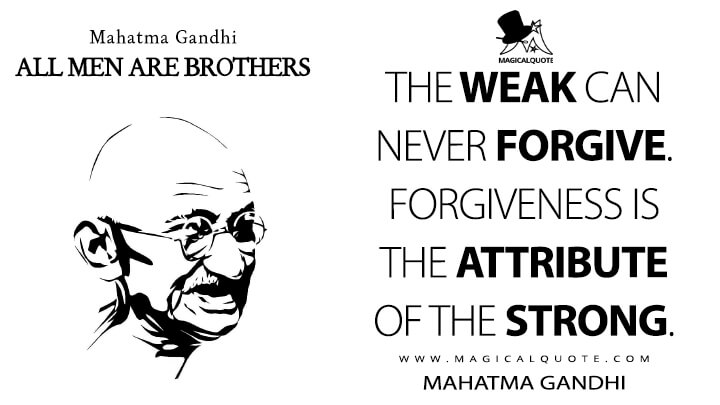
The weak can never forgive. Forgiveness is the attribute of the strong. Mahatma Gandhi, All Men are Brothers (ed. UNESCO, 1958), Page 171
When someone hurts us, our instinct is to strike back or hold a grudge. It’s easy. It feels justified. But here’s what takes real strength: choosing to forgive anyway.
Forgiveness asks something difficult of us: restraint. It requires us to resist our first impulse to rehearse the injury or to define ourselves by what was done to us. That kind of restraint takes quiet strength, the kind that doesn’t need to prove itself.
When we forgive, we are not saying the harm didn’t matter; we are saying we matter more.
Forgiveness Opens Your Future
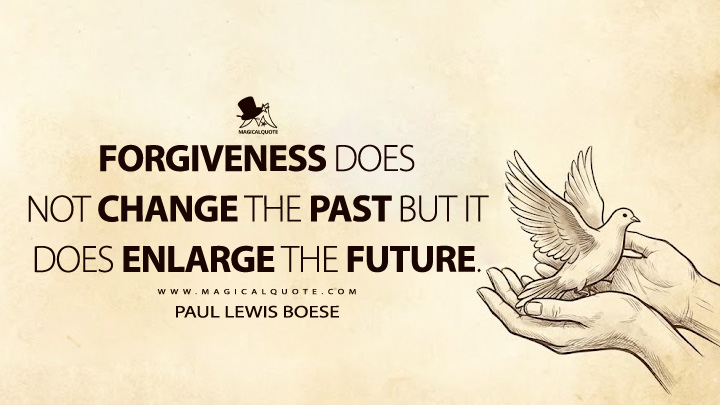
Forgiveness does not change the past but it does enlarge the future.Paul Lewis Boese, This quote was first published in the February 19, 1967 issue of Quote: The Weekly Digest, (Vol. 53, No. 8, p. 146), published by Droke House, Inc.
The past is fixed. What happened, happened. No amount of anger or resentment will undo it. But your future? That’s still being written.
Holding onto resentment keeps you locked in the same chapter, rereading the same painful pages over and over. Every time you replay what happened, you’re choosing the past over the present.
Forgiveness doesn’t erase what came before, but it clears the path ahead. It says: I’m no longer going to let this old hurt dictate my next steps.
Forgiving Yourself Is Often the Hardest Part

Self-forgiveness is difficult because we know our intentions, our doubts, and the moments where we should have known better. We hold ourselves to standards we’d never apply to anyone else.
If your best friend came to you with the same mistake, would you tell them they’re unforgivable? Or would you offer compassion?
Self-forgiveness doesn’t mean what you did was okay. It means you recognize you’re human, you’ve learned, and you deserve the chance to do better.
Forgiveness Is Wisdom, Not Naivety

Forgive. Forget. The true measure of wisdom. To know you have been harmed, by whom you have been harmed, and choose to let it all fade.Blind Man, Frankenstein (2025)
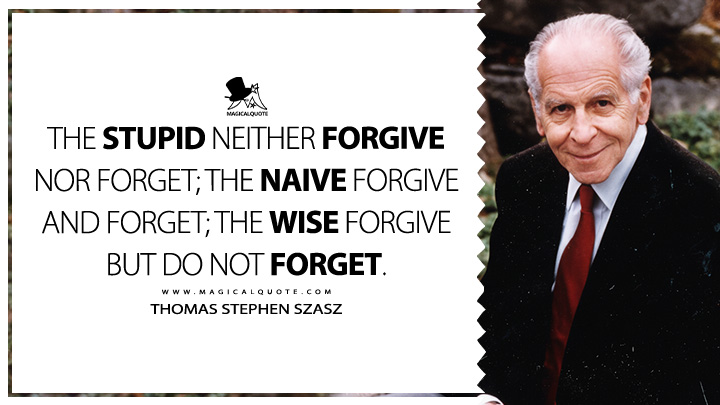
The stupid neither forgive nor forget; the naive forgive and forget; the wise forgive but do not forget. Thomas Stephen Szasz, The Second Sin (ed. Routledge & Kegan Paul, 1973), Page 51
“Forgive and forget” sounds nice, but what does it really mean? The Blind Man’s quote suggests letting it “fade,” not erasing the memory, but releasing its power over you. Szasz reminds us that wisdom keeps the lesson.
Think of it like touching a hot stove. You don’t need to stay angry at the stove, but you remember it’s hot.
Forgiveness changes not the memory itself, but the emotional charge attached to it. The story no longer controls you. You remember what happened, but you’re no longer ruled by anger or bitterness.
Memory protects us. Forgiveness frees us. Both can be true.
Forgiveness Unfolds Quietly Over Time
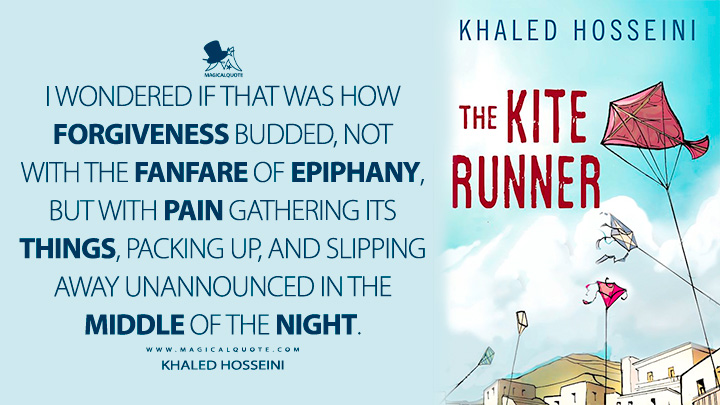
I wondered if that was how forgiveness budded, not with the fanfare of epiphany, but with pain gathering its things, packing up, and slipping away unannounced in the middle of the night. Khaled Hosseini, The Kite Runner (ed. Riverhead Books, 2003), Chapter 25, Page 359
Forgiveness rarely arrives all at once with a dramatic moment of release. It comes slowly, unevenly, like winter giving way to spring.
One day, you notice you’re thinking about it less. Another day, you realize the anger doesn’t sting the way it used to. You might forgive someone today and feel angry again tomorrow, and that’s normal.
Forgiveness is not a switch you flip. It’s a gradual loosening. Pain doesn’t leave with a grand exit; it quietly packs its bags and slips out the back door when you’re not looking.
Forgiveness Elevates You Beyond the Conflict
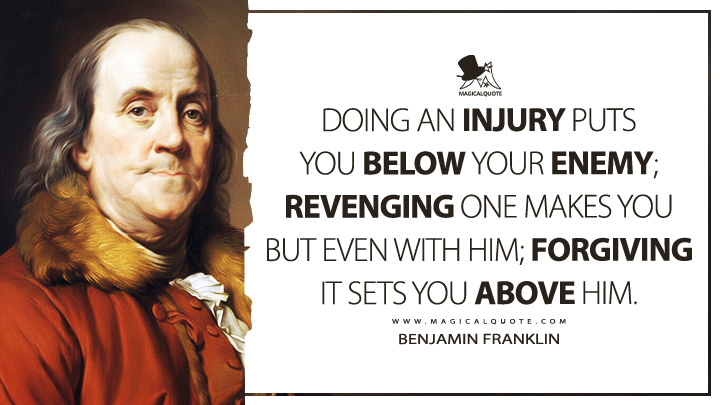
Doing an Injury puts you below your Enemy; Revenging one makes you but even with him; Forgiving it sets you above him. Benjamin Franklin, Poor Richard's Almanack (ed. The U.S.C. Publishing Co., 1914), Page 19
When someone wrongs you, revenge might feel like evening the score. But think about what revenge actually does. It keeps you tied to the harm. It keeps the conflict alive. It keeps you locked in the same cycle.
Forgiveness ends it. It says: this stops here, with me.
Choosing forgiveness doesn’t mean the other person wins. It means the conflict no longer defines you. Peace becomes more valuable than proving a point.
This doesn’t require reconciliation or even contact with the person who hurt you. Forgiveness can happen entirely within you.
Forgiveness Is a Gift You Give, Not Something You Earn
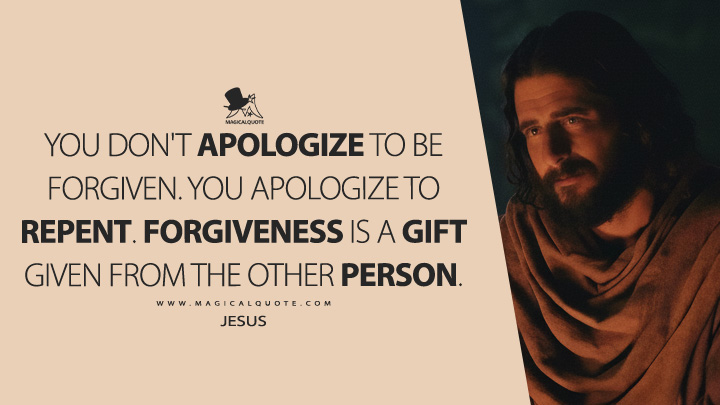
You don’t apologize to be forgiven. You apologize to repent. Forgiveness is a gift given from the other person. Jesus, The Chosen
We often think of forgiveness as something earned through apologies or changed behavior. But forgiveness is a gift, not a payment.
The person who wronged you might never apologize. They might never acknowledge what they did. They might never change. And you can still choose to forgive, not for them, but for yourself.
This doesn’t mean their actions were acceptable. It doesn’t mean you trust them again. It means you’re releasing yourself from the prison of waiting for them to make things right.
An apology is about the other person’s journey toward repentance. Forgiveness is about your journey toward freedom. They are two separate paths that sometimes meet, but do not have to.
Moving Forward: Your Path to Forgiveness
Forgiveness isn’t a single decision. It’s a path you walk. Some days will be easier than others. That’s not failure; that’s being human.
You don’t have to forgive because someone deserves it. You don’t have to forgive to be a good person. You don’t have to forgive immediately or completely.
But you deserve to be free. You deserve peace. You deserve a future not defined by your past hurts.
Forgiveness does not ask you to forget what hurt you, excuse what was wrong, or reconcile when it isn’t safe. It asks something quieter and braver:
To release what no longer serves your healing.
Sometimes forgiveness is for others.
Often it is for yourself.
Always, it is a step toward freedom.
Disclosure: Our content is reader-supported. If you click on some of our links, we may earn a commission. Read our editorial process.