45 Intriguing Quotes by Emily Dickinson
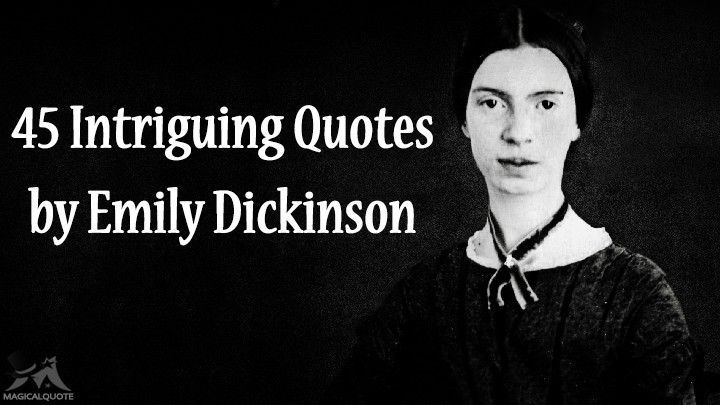
Emily Dickinson (born December 10, 1830, Amherst, Massachusetts, U.S. – died May 15, 1886, Amherst, Massachusetts, U.S.) was a 19th-century American poet whose short, powerful poems continue to shape how readers think about life, death, love, and the inner self. Although she wrote nearly 1,800 poems, only a handful were published during her lifetime, and her genius was widely recognized only after her death.
Known for her distinctive dashes, slant rhyme, and compressed language, Dickinson expressed profound ideas in remarkably few words—one reason her lines remain some of the most quoted in American literature. Writing largely from seclusion in Amherst, Massachusetts, she transformed private thought into universal insight.
The quotes below capture Dickinson’s unique voice and enduring relevance, offering reflections that feel as striking today as they did more than a century ago.
Table of Contents
Hope and Resilience
Dickinson’s reflections on hope, courage, and endurance show how the human spirit survives even its hardest seasons. Her iconic poem about the “thing with feathers” embodies this quiet strength, and the lines gathered here illustrate her belief in perseverance, healing, and steady inner fortitude.
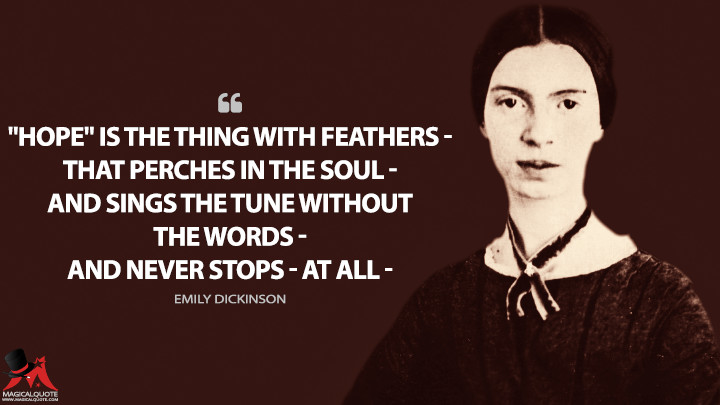
“Hope” is the thing with feathers –
That perches in the soul –
And sings the tune without the words –
And never stops – at all –

Success is counted sweetest
By those who ne’er succeed.
To comprehend a nectar
Requires sorest need.Poem no. 67: Success is counted sweetest

Luck is not chance –
It’s Toil –
Fortune’s expensive smile
Is earned –Poem no. 1350: Luck is not chance



Shame need not crouch
In such an Earth as Ours –
Shame – stand erect –
The Universe is yours.Poem no. 1304: Not with a Club, the Heart is broken
Death and Immortality
Few poets approached death with Dickinson’s combination of curiosity, clarity, and wonder. She treated mortality as an unfolding mystery shaped by love, time, and the possibility of what lies beyond the visible world. The passages collected here reveal her calm, contemplative perspective on eternity.

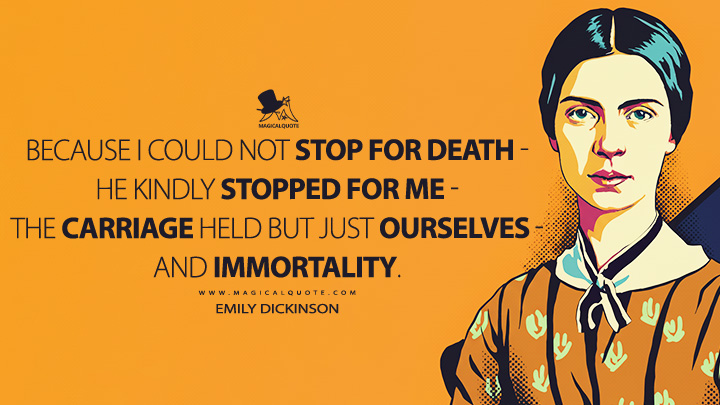
Because I could not stop for Death;
He kindly stopped for me –
The Carriage held but just Ourselves –
And Immortality.Poem no. 712: Because I could not stop for Death
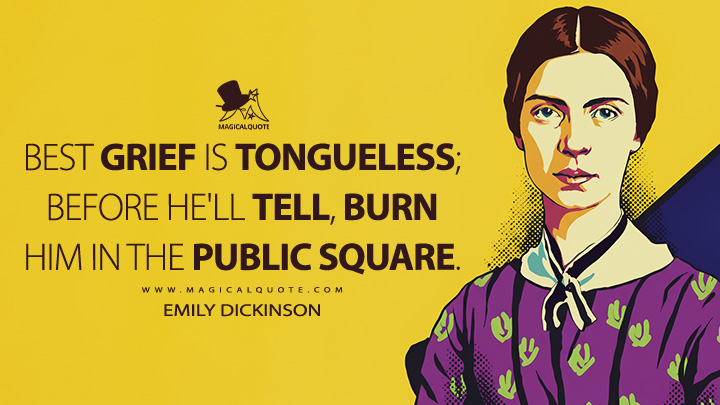
Best Grief is Tongueless – before He’ll tell –
Burn Him in the Public Square –Poem no. 793: Grief is a Mouse


Who has not found the Heaven – below –
Will fail of it above –Poem no. 1544: Who has not found the Heaven - below
Love
Dickinson’s writings on love are intimate, fervent, and deeply observant. She understood love as both grounding and transcendent, a force that shapes life and extends beyond it. These lines reflect her meditations on devotion, connection, and the enduring power of affection.


Love – is anterior to Life –
Posterior – to Death –
Initial of Creation, and
The Exponent of Earth –Poem no. 917: Love - is anterior to Life
Friendship
Although she lived quietly, Dickinson formed lasting and meaningful bonds through letters and trusted relationships. Her reflections celebrate chosen companionship, mutual understanding, and the rare comfort of being genuinely known. The quotes in this section reveal how highly she valued sincere human connection.

If I can stop one heart from breaking,
I shall not live in vainPoem no. 919: If I can stop one Heart from breaking

My friends are my estate. Forgive me then the avarice to hoard them!Letter to Samuel Bowles (late August 1858?)

Dogs. They are better than beings because they know, but do not tell.Letter to Thomas Wentworth Higginson (April 26, 1862)
Nature
From her Amherst garden, Dickinson found endless metaphors and insight in the natural world. Her observations capture nature’s subtle presence, its beauty, strangeness, and quiet magic woven into daily life. The lines collected here demonstrate her ability to uncover wonder in small details.

There is no Frigate like a Book
To take us Lands away
Nor any Coursers like a Page
Of prancing Poetry –
This Traverse may the poorest take
Without oppress of Toll –
How frugal is the Chariot
That bears the Human soul.Poem no. 1263: There is no Frigate like a Book

How strange that Nature does not knock, and yet does not intrude!Letter to James S. Cooper (about 1877)

Witchcraft was hung, in History,
But History and I
Find all the Witchcraft that we need
Around us, every Day –Poem no. 1583: Witchcraft was hung, in History
Writing and Poetry
For Dickinson, language served as a vessel for imagination, truth, and transformation. Her thoughts on reading and writing show how fully she believed in the power of words. The passages included here illustrate her understanding of literature as a force that transports, reshapes, and reveals.

A word is dead
When it is said,
Some say.
I say it just
Begins to live
That day.Poem no. 1212: A word is dead

If I read a book and it makes my whole body so cold no fire can ever warm me, I know that is poetry. If I feel physically as if the top of my head were taken off, I know that is poetry. These are the only ways I know it. Is there any other way?Letter to Thomas Wentworth Higginson (August 16, 1870)
Nature is a Haunted House – but Art – a House that tries to be haunted.Letter to Thomas Wentworth Higginson (1876)
Life and Living
Dickinson approached life with a sense of astonishment and care. Her reflections capture both the exhilaration and fragility of existence, inviting readers to notice the richness found in ordinary days. These lines explore joy, possibility, and the wonder of simply being alive.

That it will never come again
Is what makes life so sweet.Poem no. 1741: That it will never come again

To live is so startling, it leaves but little room for other occupations.Letter to Thomas Wentworth Higginson (late 1872)

Life is a spell so exquisite that everything conspires to break it.Letter to Louise and Frances Norcross (late April 1873)
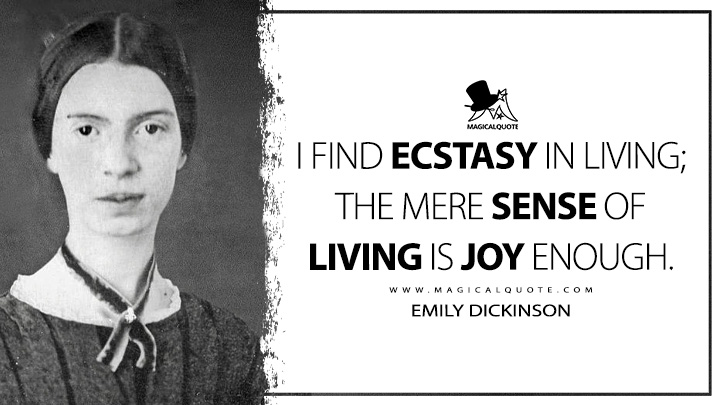
I find ecstasy in living; the mere sense of living is joy enough.Letter to Thomas Wentworth Higginson (August 16, 1870)
Mind and Inner Life
Dickinson possessed exceptional awareness of the inner world, its vastness, shadows, and uncertainties. Her insights examine thought, identity, and the shifting landscape of the self. The quotes gathered here reveal her fascination with the mysteries of consciousness.
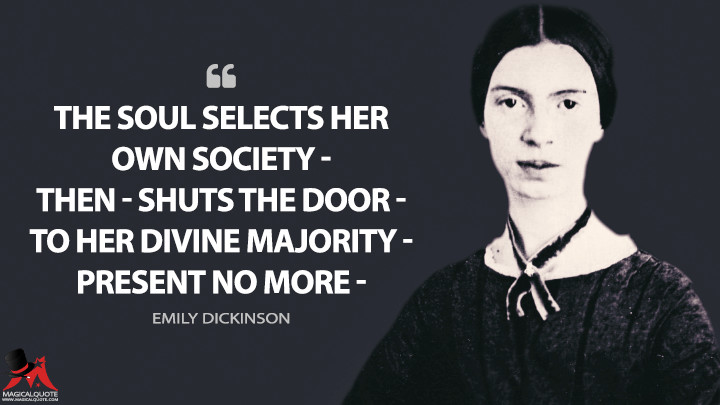
The Soul selects her own Society –
Then – shuts the Door –
To her divine Majority –
Present no more –Poem no. 303: The Soul selects her own Society
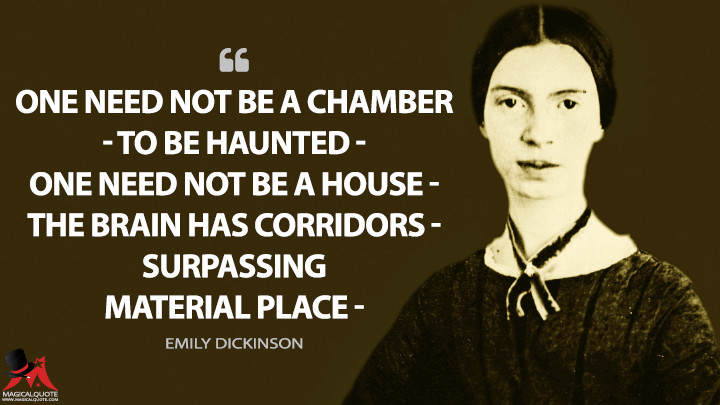
One need not be a Chamber – to be Haunted –
One need not be a House –
The Brain has Corridors – surpassing
Material Place –Poem no. 670: One need not be a Chamber - to be Haunted

Ourself behind ourself, concealed –
Should startle most –
Assassin hid in our Apartment
Be Horror’s least.Poem no. 670: One need not be a Chamber - to be Haunted

Short Quotes on Truth and Wisdom
Dickinson excelled at expressing clarity and insight in remarkably brief lines. Her concise sayings carry the weight of longer poems and offer flashes of wit and philosophical depth. The passages included here represent her most compact yet enduring ideas of wisdom.

Truth is such a rare thing, it is delightful to tell it.Letter to Thomas Wentworth Higginson (August 16, 1870)

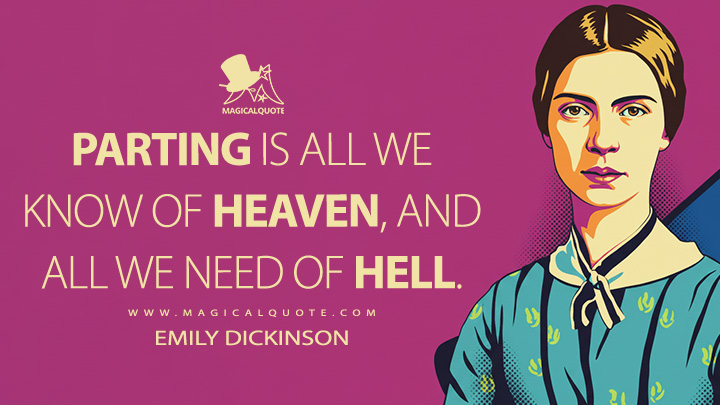
Parting is all we know of heaven,
And all we need of hell.Poem no. 1732: My life closed twice before its close

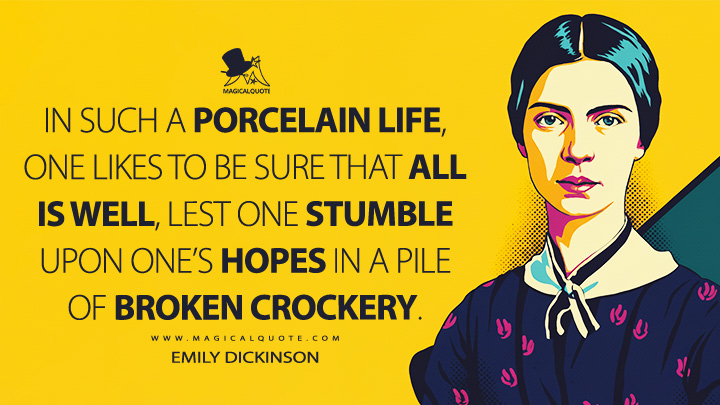
In such a porcelain life, one likes to be sure that all is well, lest one stumble upon one’s hopes in a pile of broken crockery.Letter to Samuel Bowles (late August 1858?)

Even the Possible has it’s insoluble particle.Letter to Thomas Wentworth Higginson (September 26, 1870)


Enough is so vast a sweetness, I suppose it never occurs, only pathetic counterfeits.Letter to Thomas Wentworth Higginson (September 26, 1870)

Portraits are to daily faces
As an Evening West,
To a fine, pedantic sunshine –
In a satin Vest!Poem no. 170: Portraits are to daily faces
Disclosure: Our content is reader-supported. If you click on some of our links, we may earn a commission. Read our editorial process.