The writer must believe that what he is doing is the most important thing in the world. And he must hold to this illusion even when he knows it is not true.
The writer is situated in his time. Every word has consequences. Every silence, too.[L’écrivain est en situation dans son époque : chaque parole a des retentissements. Chaque silence aussi.]
The writer is delegated to declare and to celebrate man’s proven capacity for greatness of heart and spirit – for gallantry in defeat – for courage, compassion and love. In the endless war against weakness and despair, these are the bright rally-flags of hope and of emulation.
The role of the writer is not to say what we can all say but what we are unable to say.
The public takes from a writer, or a writing, what it needs and lets the remainder go. but what they take is usually what they need least and what they let go is what they need most.
The great novelists are philosophical novelists – that is, the contrary of thesis-writers.[Les grands romanciers sont des romanciers philosophes, c’est-à-dire le contraire d’écrivains à thèse.]
The good writers touch life often. The mediocre ones run a quick hand over her. The bad ones rape her and leave her for the flies.
The final lesson a writer learns is that everything can nourish the writer. The dictionary, a new word, a voyage, an encounter, a talk on the street, a book, a phrase heard.
The best author will be he who is ashamed to become one.[Der beste Autor wird der sein, welcher sich schämt, Schriftsteller zu werden.]
That is how you get to be a writer, incidentally: you feel somehow marginal, somehow slightly off-balance all the time.
People assume any twentieth-century white male writer must be an alcoholic.
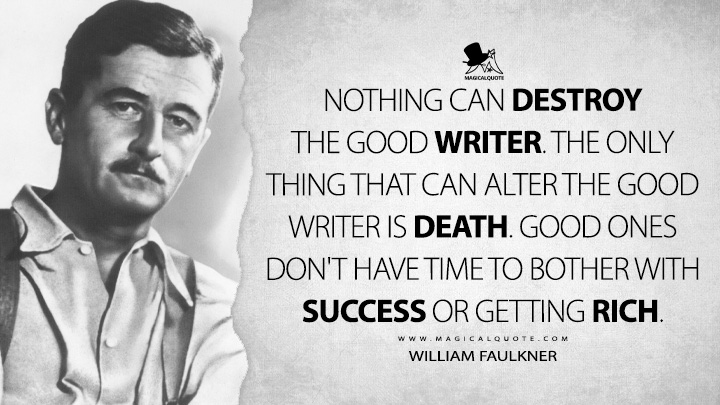
Nothing can destroy the good writer. The only thing that can alter the good writer is death. Good ones don’t have time to bother with success or getting rich.