The programme of becoming happy, which the pleasure principle imposes on us, cannot be fulfilled; yet we must not – indeed, we cannot – give up our efforts to bring it nearer to fulfilment by some means or other.[Das Programm, welches uns das Lustprinzip aufdrängt, glücklich zu werden, ist nicht zu erfüllen, doch darf man – nein, kann man – die Bemühungen, es irgendwie der Erfüllung näherzubringen, nicht aufgeben.]
It is impossible to escape the impression that people commonly use false standards of measurement – that they seek power, success and wealth for themselves and admire them in others, and that they underestimate what is of true value in life.[Man kann sich des Eindrucks nicht erwehren, daß die Menschen gemeinhin mit falschen Maßstäben messen, Macht, Erfolg und Reichtum für sich anstreben und bei anderen bewundern, die wahren Werte des Lebens aber unterschätzen.]
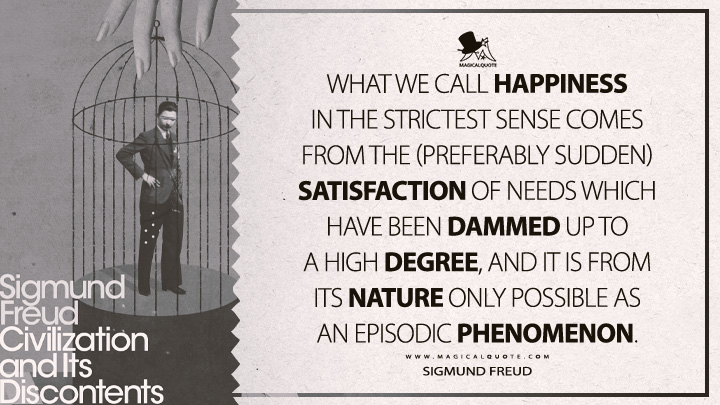
What we call happiness in the strictest sense comes from the (preferably sudden) satisfaction of needs which have been dammed up to a high degree, and it is from its nature only possible as an episodic phenomenon.[Was man im strengsten Sinne Glück heißt, entspringt der eher plötzlichen Befriedigung hoch aufgestauter Bedürfnisse und ist seiner Natur nach nur als episodisches Phänomen möglich.]
We are never so defenceless against suffering as when we love.[Niemals sind wir ungeschützter gegen das Leiden, als wenn wir lieben.]
Towards the outside, at any rate, the ego seems to maintain clear and sharp lines of demarcation. There is only one state – admittedly an unusual state, but not one that can be stigmatized as pathological – in which it does not do this. At the height of being in love the boundary between ego and object threatens to melt away. Against all the evidence of his senses, a man who is in love declares that ‘I’ and ‘you’ are one, and is prepared to behave as if it were a fact.[Aber nach außen wenigstens scheint das Ich klare und scharfe Grenzlinien zu behaupten. Nur in einem Zustand, einem außergewöhnlichen zwar, den man aber nicht als krankhaft verurteilen kann, wird es anders. Auf der Höhe der Verliebtheit droht die Grenze zwischen Ich und Objekt zu verschwimmen. Allen Zeugnissen der Sinne entgegen behauptet der Verliebte, daß Ich und Du eines seien, und ist bereit, sich, als ob es so wäre, zu benehmen.]
It is impossible to overlook the extent to which civilization is built up upon a renunciation of instinct.[Ist es unmöglich zu übersehen, in welchem Ausmaß die Kultur auf Triebverzicht aufgebaut ist.]
Beauty has no obvious use; nor is there any clear cultural necessity for it. Yet civilization could not do without it.[Ein Nutzen der Schönheit liegt nicht klar zutage, ihre kulturelle Notwendigkeit ist nicht einzusehen, und doch könnte man sie in der Kultur nicht vermissen.]
A love that does not discriminate seems to me to forfeit a part of its own value, by doing an injustice to its object; and secondly, not all men are worthy of love.[Eine Liebe, die nicht auswählt, scheint uns einen Teil ihres eigenen Werts einzubüßen, indem sie an dem Objekt ein Unrecht tut. Und weiter: es sind nicht alle Menschen liebenswert.]
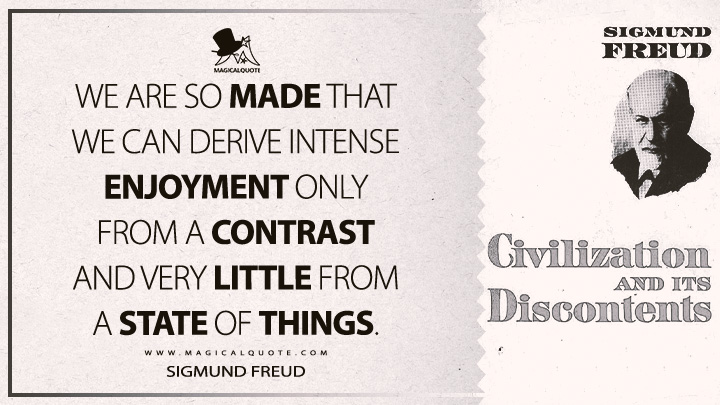
We are so made that we can derive intense enjoyment only from a contrast and very little from a state of things.[Wir sind so eingerichtet, daß wir nur den Kontrast intensiv genießen können, den Zustand nur sehr wenig.]
The time comes when each one of us has to give up as illusions the expectations which, in his youth, he pinned upon his fellow men, and when he may learn how much difficulty and pain has been added to his life by their ill-will.[Jeder von uns kommt dahin, die Erwartungen, die er in der Jugend an seine Mitmenschen geknüpft, als Illusionen fallenzulassen, und kann erfahren, wie sehr ihm das Leben durch deren Übelwollen erschwert und schmerzhaft gemacht wird.]
The liberty of the individual is no gift of civilization. It was greatest before there was any civilization, though then, it is true, it had for the most part no value, since the individual was scarcely in a position to defend it.[Die individuelle Freiheit ist kein Kulturgut. Sie war am größten vor jeder Kultur, allerdings damals meist ohne Wert, weil das Individuum kaum imstande war, sie zu verteidigen.]
The first requisite of civilization, therefore, is that of justice.[Die nächste kulturelle Anforderung ist also die der Gerechtigkeit.]
Civilization And Its Discontents Videos: